
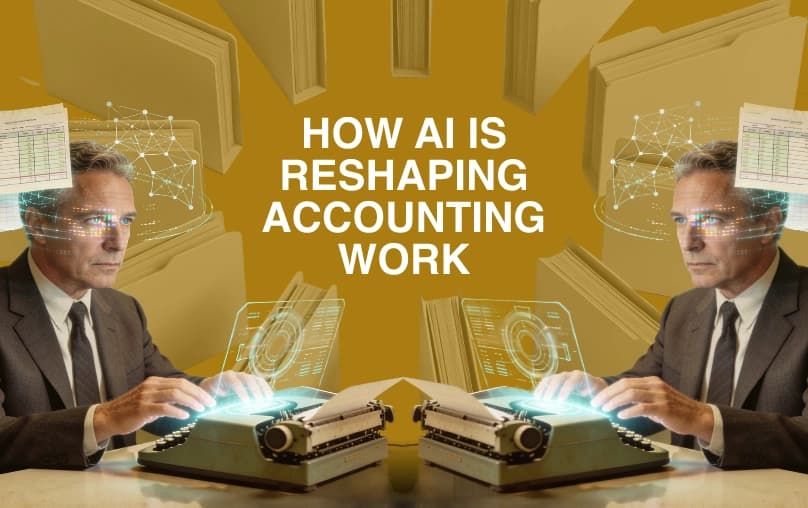

From 2019 to Today: How Accounting Work has Quietly Transformed
Picture the accounting team at a mid-size firm in 2019. Three people spend two days every month reconciling vendor invoices cross-checking purchase orders, flagging discrepancies, flagging duplicates. It's tedious, it's necessary, and it takes exactly the kind of focused human attention that feels like it should matter.
That same firm in 2026? One person. Half a day. An AI tool handles the rest, reading contracts, matching invoices to terms, and flagging anything that doesn't line up. The other two team members moved to client advisory work, and the firm's revenue per head went up.
This isn't a story from a Silicon Valley startup or a Big Four press release. Variations of it are happening across accounting firms in every state, every sector, and every firm size. A 2024 AICPA survey found that 65% of small accounting firms with fewer than 10 employees are already using some form of AI in their practice.
The question for any working accountant in America today isn't whether AI affects your work as it already does. The real question is: which parts of your work are being reshaped, and which parts become more valuable as AI takes everything else off the table?
That's what this blog answers with real data, real tools, and no noise.
Accounting has been Automating for Decades. AI is Not the First Wave, It’s the Biggest One
Every generation of accountants has seen parts of their work handed over to machines. Understanding that history puts AI in context and makes it clear why this shift is different in both scale and speed.
These systems improved efficiency, but they could only do what they were programmed to do.
These were not experimental systems. They were deployed at scale inside real financial institutions, fundamentally changing how risk, compliance, and review processes operate.
- Read contracts
- Interpret regulatory documents
- Generate financial narratives
Earlier automation worked with spreadsheets. This generation works with language, context, and meaning. That shift expanded AI’s role across much larger parts of the accounting workflow.
How Fast AI is Being Adopted in Finance and Accounting
McKinsey surveyed 102 CFOs across industries and global regions for its November 2025 Finance AI report.
The speed of adoption in just one year was striking:
• 44% of CFOs now use Gen AI across more than five finance functions, up from 7% the previous year
• 65% of organizations plan to increase AI investment
• 42% of finance and accounting tasks can now be automated
One signal that often goes unnoticed: Graduate openings at the Big Four fell 44% year-over-year in 2024, with KPMG cutting some cohorts by nearly 30%. This isn't firms laying off experienced accountants it's firms needing fewer entry-level people to do the work that AI now handles. The industry is already reshaping from the base up.
How Leading Firms are Using AI
Adoption data shows how fast AI is spreading. To understand how it is being used, you have to look at the largest firms.
| Company Name | AI Tool |
|---|---|
| Deloitte | Argus reviews contracts and documents in minutes. Omnia supports audit planning and risk assessment. |
| Ernst & Young (EY) | Helix analyzes full datasets instead of relying on sampling. |
| PwC | GL.ai detects anomalies in general ledger data |
| KPMG | Clara automates routine audit tasks. Ignite integrates AI and analytics across financial processes. |
AI is not being tested in pilots, it is being embedded into core operations.
Which Parts of Accounting has AI Already Taken on and How Deeply
The chart below is based on published research from McKinsey, KPMG, AICPA, Deloitte, and EY. The percentages represent the estimated share of tasks within each function that AI currently handles.
AI Penetration Across Accounting Functions
Percentages represent directional estimates synthesized from McKinsey, KPMG, AICPA, EY, and Deloitte published research (2024–2025). No single source publishes this breakdown in this exact form.
The pattern is consistent:
• High-volume, rule-based work is heavily automated
• Analytical work is shared between AI and humans
• Judgment-driven work remains human-led
The middle i.e reporting, audit analysis, forecasting, is where the balance is still evolving.
Three Areas Where AI has Delivered Measurable Results
1. Accounts Payable: Every company negotiates contracts with its vendors, pricing tiers, volume discounts, rebate structures, and payment terms designed to protect margins.
On paper, everything is clearly defined. In practice, enforcing those terms consistently is far more difficult. A vendor may invoice at the standard rate even after volume thresholds have been crossed. Discounts that apply quarterly may not be reflected in individual invoices.
Duplicate charges and out-of-policy expenses slip through not because they are hidden, but because reviewing every transaction in detail is simply not feasible on a scale. Across thousands, sometimes millions of transactions, even highly disciplined finance teams rely on sampling, spot checks, and periodic reviews.
This is where AI fundamentally changes the process. Modern systems can:
• Read and interpret contract terms in detail
• Track cumulative vendors spend across months or quarters
• Compare every invoice not just a subset against agreed pricing and conditions
And more importantly, they do this continuously. Not at month-end. Not during audits.
But in real time, as transactions occur.
That difference matters.
Because now, instead of discovering issues after the fact, companies can identify them as they happen before they compound.
This shift from periodic review to continuous enforcement is a clear example of how AI is reshaping financial operations, capacity, and compliance across finance teams.
2. Fraud Detection: Traditional audit relied on sampling reviewing a subset of transactions and drawing conclusions about the whole. It was a practical compromise.
AI removes that limitation. Today, firms can analyze:
• Entire transaction datasets
• All journal entries
• Anomalies across the full population
For the first time, “we checked everything” is no longer an approximation.
3. Financial Reporting: Financial reporting has always required translating numbers into explanations, what changed, why it changed, and what it means. Much of this follows structured patterns. AI can now generate:
• Variance explanations
• Draft commentary
• Structured summaries
Not perfectly but enough to eliminate the most time-consuming step: starting from scratch. This allows professionals to focus on interpretation rather than assembly.
The Parts of Accounting that AI Cannot Reach
Every AI system operates on patterns derived from historical data. When situations fall outside those patterns where context, ambiguity, or judgment is required AI reaches its limit.
| AI's Operational Territory | What Remains Human Work |
|---|---|
| Processing large volumes of structured data | Professional judgment |
| Monitoring transactions for anomalies | Ethical accountability |
| Checking compliance against defined rules | Client advisory |
| Generating draft outputs | Decision-making under uncertainty |
The Bottom Line on the Impact of AI on Accounting
AI is already reshaping accounting.
• 42% of finance tasks can be automated
• AI systems are handling millions of compliance cases
• Firms are restructuring how work gets done
But the role of the accountant is not disappearing. It is shifting.
From processing → To interpreting
From execution → To judgment

Shekhar Mehrotra
Founder and Chief Executive Officer
Shekhar Mehrotra, a Chartered Accountant with over 12 years of experience, has been a leader in finance, tax, and accounting. He has advised clients across sectors like infrastructure, IT, and pharmaceuticals, providing expertise in management, direct and indirect taxes, audits, and compliance. As a 360-degree virtual CFO, Shekhar has streamlined accounting processes and managed cash flow to ensure businesses remain tax and regulatory compliant.
You might also like:
Listen Exclusive Podcast On