
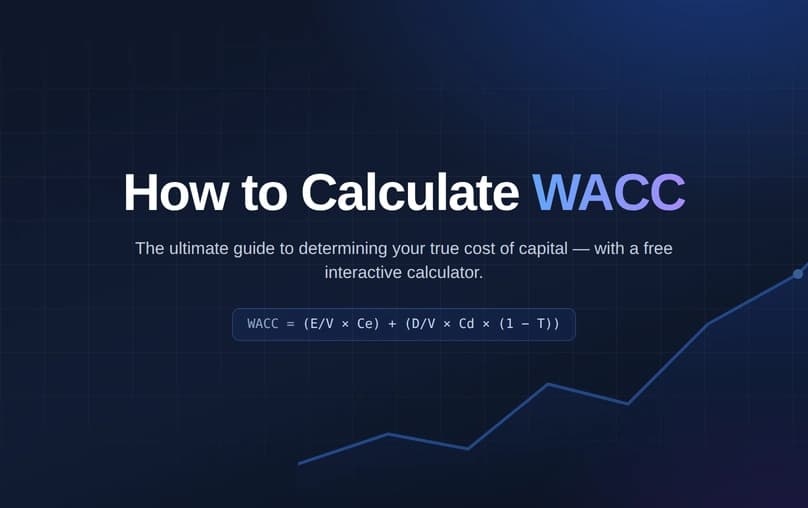
How to Calculate WACC: The Ultimate Guide to Determining Your Cost of Capital
Published on: Jul 21, 2026

If you are a mid-market CEO preparing for an acquisition, or a founder modeling out a major capital expansion in 2026, relying on top-line revenue metrics is no longer enough. Institutional investors, private equity firms, and corporate valuation experts are looking at one specific, highly complex metric to determine what your company is actually worth: The Weighted Average Cost of Capital (WACC).
Capital is never free. Whether you are issuing equity to venture capitalists or taking on commercial debt, every dollar funding your operations carries an expected rate of return. WACC calculates that blended cost.
It serves as the ultimate "hurdle rate." If your company’s return on invested capital (ROIC) is lower than your WACC, you are technically destroying value.
Because WACC is the foundational discount rate used in Discounted Cash Flow (DCF) models, a miscalculation of even half a percent can swing your company's valuation by millions of dollars. In this guide, we will break down the advanced components of WACC, explain the formula, and provide a dynamic calculator to help you estimate your true cost of capital.
The Components of WACC
WACC is not a simple metric you can pull from a standard balance sheet. It is a multi-variable calculation that weighs the proportional cost of your equity against the after-tax cost of your debt.
To calculate it, you must define five distinct variables:
1. Market Value of Equity (E)
For a publicly traded company, this is the market capitalization (share price multiplied by outstanding shares). For private companies, calculating the market value of equity requires a formal business valuation or a multiple-based estimate, rather than simply relying on book value.
2. Market Value of Debt (D)
This is the total outstanding value of your company's short-term and long-term debt.
3. Cost of Equity (Ce)
This is the trickiest variable. Equity investors take on more risk than debt holders, so they demand a higher return. The Cost of Equity is typically calculated using the Capital Asset Pricing Model (CAPM), which factors in the current Risk-Free Rate (Pro-Tip: tie this to the current US Treasury Yield Curve), your company’s Beta (volatility compared to the market), and the Equity Risk Premium.
The CAPM formula itself looks like this:
- Rf = Risk-Free Rate (typically the yield on a 10-year US Treasury)
- β (Beta) = Your company's volatility relative to the overall market
- (Rm − Rf) = The Equity Risk Premium (the extra return investors expect over the risk-free rate)
For example, with a 4.3% risk-free rate, a Beta of 1.2, and a 5.5% equity risk premium, your Cost of Equity would be 4.3% + (1.2 × 5.5%) = 10.9%. Note that Beta is straightforward for public companies but must be estimated for private firms using comparable listed companies.
4. Cost of Debt (Cd)
This is the effective interest rate your company pays on its borrowed funds. In the shifting 2026 interest rate environment, accurately calculating your current yield to maturity on outstanding debt is critical.
5. The Corporate Tax Rate (T)
Because interest payments on debt are tax-deductible in the United States, debt is generally cheaper than equity. The WACC formula applies a "tax shield" to the cost of debt using your effective corporate tax rate.
The WACC Formula Explained
Once you have your variables, they are plugged into the following financial modeling formula:
- V = Total Market Value (Equity + Debt)
- E/V = Percentage of financing that is Equity
- D/V = Percentage of financing that is Debt
- (1 - T) = The Tax Shield
By multiplying the cost of each capital source by its proportional weight and adding them together, you arrive at your company's Weighted Average Cost of Capital.
A Worked WACC Example
Formulas are easier to trust once you see them in action. Imagine a mid-market company with the following capital structure:
- Market Value of Equity (E) = $5,000,000
- Market Value of Debt (D) = $2,000,000
- Cost of Equity (Ce) = 10%
- Cost of Debt (Cd) = 6%
- Corporate Tax Rate (T) = 21%
Step 1 — Find the total capital (V). V = E + D = $5,000,000 + $2,000,000 = $7,000,000.
Step 2 — Calculate the weights. Equity weight (E/V) = $5,000,000 ÷ $7,000,000 = 71.43%. Debt weight (D/V) = $2,000,000 ÷ $7,000,000 = 28.57%.
Step 3 — Apply the tax shield to debt. After-tax cost of debt = 6% × (1 − 0.21) = 6% × 0.79 = 4.74%.
Step 4 — Blend the two costs.
= 7.14% + 1.35% = 8.50%
This company's WACC is 8.50% — meaning any new project or acquisition it pursues must generate a return above 8.50% simply to break even on the cost of the capital funding it. Try the exact same numbers in the calculator below to see them recalculate live.
🧮 WACC Calculator
Use the calculator below to model your company's current WACC. Note: For the most accurate DCF valuation, ensure you are using market values, not book values.
The Danger of DIY Valuation
While our calculator provides a powerful baseline estimate, WACC is a highly sensitive metric.
Determining the correct "Beta" for a private company, accurately estimating the current Equity Risk Premium, and properly weighting complex debt instruments (like convertible notes or preferred stock) requires rigorous financial expertise. If you use book values instead of market values, or fail to accurately calculate your cost of equity via CAPM, your resulting WACC will be entirely inaccurate.
If you are using that flawed WACC to value your company for a sale or to pitch institutional investors, you risk leaving millions of dollars on the table or failing due diligence entirely.
Elevate Your Financial Strategy
You shouldn't be guessing at your cost of capital. Navigating M&A prep, securing institutional funding, and building bulletproof Discounted Cash Flow models requires executive-level financial architecture.
At ProcStat, our Fractional CFO and Controller Services provide mid-market U.S. companies with the sophisticated financial modeling previously reserved for Fortune 500 enterprises.
Speak with an Outsourced CFODisclaimer: This article and the accompanying calculator are provided for general educational purposes only and do not constitute financial, investment, tax, or valuation advice. WACC estimates depend on assumptions that vary by company and market conditions. Consult a qualified financial professional before making decisions based on these figures.

Shekhar Mehrotra
Founder and Chief Executive Officer
Shekhar Mehrotra, a Chartered Accountant with over 18 years of experience, has been a leader in finance, tax, and accounting. He has advised clients across sectors like infrastructure, IT, and pharmaceuticals, providing expertise in management, direct and indirect taxes, audits, and compliance. As a 360-degree virtual CFO, Shekhar has streamlined accounting processes and managed cash flow to ensure businesses remain tax and regulatory compliant.
You might also like:
- How to Set Up a Chart of Accounts: A Step-by-Step Guide
- Top Accounts Payable Outsourcing Companies in the USA (2026)
- Adjusted EBITDA: What It Means, Why It Matters & Common Mistakes Businesses Make while calculating Adjusted EBITA
- Tariff Impacts: Top 10 Accounting and Financial Reporting Issues Every Business Should Watch
Listen Exclusive Podcast On