
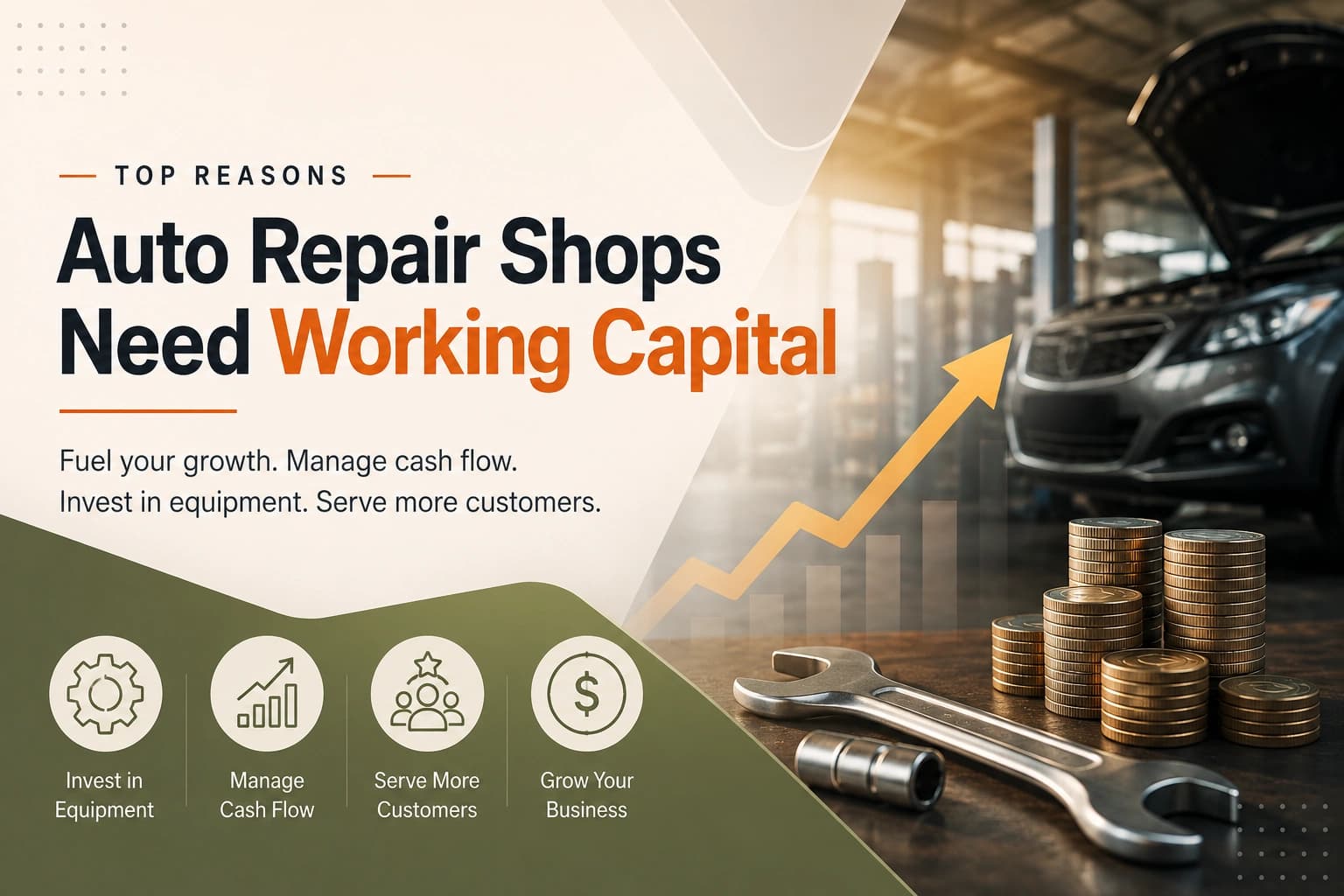

Running a successful auto repair shop requires more than just top-tier mechanical skills; it requires constant, reliable cash flow. Between purchasing specialized parts, maintaining heavy machinery, and keeping skilled technicians on payroll, the overhead in the automotive repair industry is exceptionally high.
Even a highly profitable garage can find itself cash-strapped if invoices are delayed or a slow season hits. This is where working capital—the money used to cover daily operational expenses—becomes the lifeblood of the business.
If you are feeling the cash flow crunch or planning your next phase of growth, here are the top reasons auto repair shops need working capital.
1. Upgrading Diagnostic Equipment and Tools
Modern vehicles are essentially rolling computers. To service EVs, hybrids, and newer internal combustion engines, your shop needs state-of-the-art diagnostic software and scanners.
- The Real Cost of Tech: Entry-level multi-brand scanners might run around $1,500, but professional-grade equipment like a new Snap-on Zeus+ or Triton scanner can easily cost between $2,300 and upwards of $4,000. Add in ADAS (Advanced Driver Assistance Systems) calibration kits, and a single bay upgrade can clear $15,000.
- The Solution: Equipment financing or a working capital injection allows you to invest in the latest technology without draining your emergency cash reserves. This ensures your team can efficiently diagnose and repair any vehicle that pulls into a bay—and allows you to charge premium labor rates for specialized diagnostics.
2. Navigating Seasonal Lulls
The auto repair industry is heavily seasonal. You likely see a massive influx of customers right before summer road trips or during the first hard freeze of winter, followed by notoriously slow months in the spring and fall.
- Working capital acts as a financial bridge during those slow periods. It ensures you can confidently cover fixed costs—like rent, utilities, and insurance—without panicking when the bays are temporarily empty.
3. The "Parts-Before-Payment" Cash Flow Trap
In the automotive repair industry, the financial math often works against shop owners from day one. When a vehicle rolls into the bay, parts—like brake rotors, alternators, or a set of tires—must be ordered immediately. That expense hits your bank account the moment the supplier ships the parts.
Meanwhile, if you are doing warranty work, dealing with an insurance collision claim, or servicing commercial fleet accounts, you might be waiting 30, 60, or even 90 days to collect on a massive repair job.
- The Payroll Pressure: During this waiting period, your shop's overhead doesn't pause. Experienced technicians are earning competitive industry hourly rates. Payroll must be met on Friday, regardless of whether a commercial fleet has paid its Net-60 invoice.
- The Solution: This massive timing mismatch between immediate parts expenses and delayed revenue is exactly why highly profitable shops suddenly find themselves cash-strapped. A working capital injection bridges this gap, providing the float you need to cover payroll and order inventory for the next job while you wait for large invoices to clear.
4. Bulk Purchasing Parts and Inventory
Supply chain unpredictability can bring an auto shop to a grinding halt. If a customer has to wait a week for a standard part, they will likely take their vehicle elsewhere.
- Bulk Discounts: Having cash on hand allows you to buy common inventory (oil, filters, brake pads, tires) in bulk, securing significant supplier discounts.
- Turnaround Time: Stocking essential inventory on your own shelves reduces turnaround time, dramatically improving customer satisfaction and retention.
5. Hiring and Retaining Top-Tier Mechanics
There is a massive shortage of skilled automotive technicians nationwide. To attract and keep the best mechanics, you have to offer competitive wages, benefits, and potentially signing bonuses.
- Working capital provides the financial padding necessary to meet payroll on time, every time, even if a few major fleet clients are late paying their invoices. It also gives you the flexibility to hire an extra set of hands before your busy season hits, so you aren't turning away profitable work.
6. Facility Expansion and Bay Renovations
If your mechanics are constantly waiting for an open lift, you are actively losing money. Growth requires physical space.
- Whether you need to install a new hydraulic lift, repave a pothole-filled parking lot, or expand into the commercial space next door, working capital provides the upfront funding necessary to increase your daily vehicle capacity.
7. Aggressive Local Marketing
Word-of-mouth is great, but relying on it exclusively limits your growth. To capture new customers moving into your area, you need to be highly visible.
- Working capital can fund targeted local SEO campaigns, Google Ads, direct mailers, or a modern website overhaul. Marketing isn't an expense; it’s an investment that pays for itself in new customer acquisition.
The Best Working Capital Options for Auto Repair Shops
Not all business funding is created equal. Depending on whether you need quick cash for payroll or a long-term loan for a new hydraulic lift, here are the most common financial tools available to mechanics:
Equipment Financing
The best route for purchasing heavy machinery like lifts or diagnostic tools. The equipment serves as collateral, securing lower rates and terms between 2 to 7 years.
Business Line of Credit
A financial safety net. You are approved for a set limit (e.g., $50,000) but only pay interest on what you draw. Perfect for seasonal lulls or bulk part discounts.
Term Loans
A traditional lump sum repaid over 1 to 5 years. Ideal for medium-scale investments like marketing overhauls or minor facility renovations.
U.S. Small Business Administration's Program - SBA 7(a) Loans
Government-backed loans offering the best rates (up to 25 years). Requires excellent credit and 30-90 days to fund. Best for real estate or acquisitions.
Merchant Cash Advance (MCA)
A quick advance based on future credit card sales. Funding in 24-48 hours but with high rates. Should strictly be used for emergencies.
Interactive Auto Shop Loan Calculator
Type a value or adjust the sliders to estimate your monthly payments.
Auto Repair Shop Financing FAQs
How fast can I get working capital for my repair shop?
If you apply with an alternative lender or revenue-based financing company, working capital can often be funded in as little as 24 to 48 hours. Traditional bank loans or SBA 7(a) loans typically take 30 to 90 days to process and fund.
What credit score is needed for an auto shop loan?
Traditional bank loans generally require a FICO score of 680 or higher. However, equipment financing and merchant cash advances (MCAs) are heavily based on your shop's monthly cash flow and the collateral itself, meaning owners with scores as low as 550 to 600 can still qualify.
Can I finance expensive diagnostic equipment like scanners?
Yes. Equipment financing is specifically designed for purchasing heavy machinery (like lifts) or advanced diagnostic software (like Snap-on scanners). The equipment itself serves as the collateral for the loan, which typically results in lower interest rates and 2 to 7-year repayment terms.
What documents do I need to apply?
For most fast-funding working capital loans, you will need 3 to 6 months of business bank statements, a government-issued ID, a voided business check, and basic proof of ownership. Larger SBA loans will also require 1 to 2 years of tax returns, a profit and loss (P&L) statement, and a balance sheet.
The Bottom Line
An auto repair shop cannot run on empty. Whether you are dealing with a temporary cash flow gap, looking to purchase a new two-post lift, or ready to hire a master technician, a working capital loan can provide the fuel your business needs to accelerate.
Don't let a lack of cash flow put the brakes on your shop's potential.

Shekhar Mehrotra
Founder and Chief Executive Officer
Shekhar Mehrotra, a Chartered Accountant with over 18 years of experience, has been a leader in finance, tax, and accounting. He has advised clients across sectors like infrastructure, IT, and pharmaceuticals, providing expertise in management, direct and indirect taxes, audits, and compliance. As a 360-degree virtual CFO, Shekhar has streamlined accounting processes and managed cash flow to ensure businesses remain tax and regulatory compliant.